


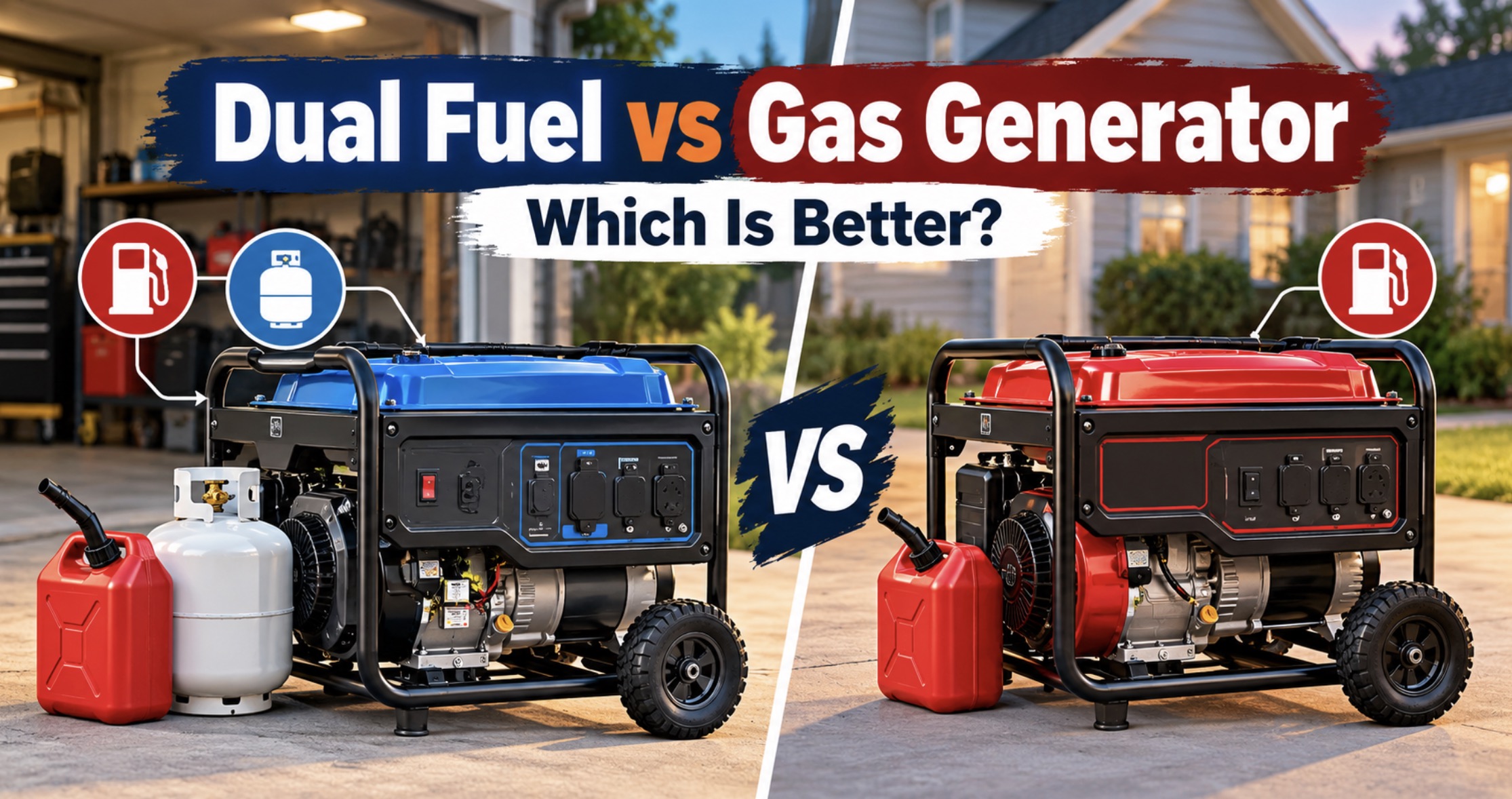
Dual Fuel vs Gas Generator: Which Is Better?
* This site contains affiliate links for which we may be compensated.
When shopping for a portable generator, one of the biggest decisions is whether to buy a dual fuel generator or a traditional gasoline-only model. Both can provide reliable electricity during power outages, camping trips, RV adventures, and outdoor work, but they differ in fuel flexibility, running costs, power output, storage convenience, maintenance requirements, and long-term ownership. Choosing the wrong fuel type could leave you spending more than necessary or struggling to find fuel when you need emergency power.
A dual fuel generator can typically operate on gasoline or propane, allowing you to choose between two fuel sources. A gasoline-only generator runs exclusively on gasoline and generally has a simpler fuel system. Although dual fuel generators are often more versatile, gasoline-only models can still be excellent choices for buyers who want straightforward operation, strong power output, and a lower initial purchase price.
The best choice depends on how frequently you use your generator, whether you need backup power during emergencies, how much electricity you require, and whether propane is readily available in your area.
Before comparing fuel types, it is also worth determining how much electricity your appliances require. The Generator Load Calculation Sheet and Formula can help you calculate running watts, starting watts, and the generator capacity you need.
What Is a Dual Fuel Generator?
A dual fuel generator is a portable generator designed to operate using two different fuel sources. Most consumer dual fuel generators use gasoline and propane, although certain models and configurations support other combinations.
Dual fuel generators usually include:
- A gasoline fuel tank
- A propane connection
- A fuel selector switch, dial, or manufacturer-approved switching mechanism
- A propane regulator and compatible fuel hose
- A carburetor or fuel-delivery system designed for both fuels
- Fuel-specific operating instructions
When operating on gasoline, the generator draws fuel from its built-in tank. When operating on propane, it receives fuel from an external propane cylinder through a regulator and hose.
Some models allow switching between gasoline and propane while running, but others require the generator to be stopped first. Always follow the switching procedure for your specific model.
Popular generator manufacturers offering dual fuel models include Champion, Westinghouse, DuroMax, Firman, and WEN.

Westinghouse 12500 Watt Dual Fuel Home Backup Portable Generator, Remote Electric Start, Transfer Switch Ready, Gas and Propane Powered

Westinghouse 13500 Peak Watt Dual Fuel Home Backup Portable Generator, Remote Electric Start, Transfer Switch Ready, Gas and Propane Powered

Westinghouse 14500 Peak Watt Dual Fuel Home Backup Portable Generator, Remote Electric Start, Transfer Switch Ready, Gas and Propane Powered
What Is a Gasoline-Only Generator?
A gasoline-only generator is designed to operate exclusively on gasoline. Most conventional portable generators use a small four-stroke engine that burns gasoline to turn an alternator and produce electricity.
Gasoline generators are widely available in several categories:
- Conventional open-frame portable generators
- Compact inverter generators
- High-output home backup generators
- Jobsite generators
- RV and camping generators
One advantage of gasoline-only generators is their relatively straightforward fuel system. There is no propane regulator, separate fuel hose, or fuel selector mechanism to manage.
However, gasoline degrades during storage, and prolonged inactivity can lead to carburetor problems.
Westinghouse 12500 Watt Dual Fuel Home Backup Portable Generator, Remote Electric Start, Transfer Switch Ready, Gas and Propane Powered

Oxseryn 4400-Watts Inverter Generator, Open Frame Generator Gas Powered, Emergency Home Backup, RV Ready 30A Outlet, EPA Compliment

DuroStar DS13000MX 13,000-Watt 500cc Dual Fuel Portable Generator - Gas and Propane, Remote Electric Start, Whole Home Power Backup, Transfer Switch Ready, RV & Emergency Ready
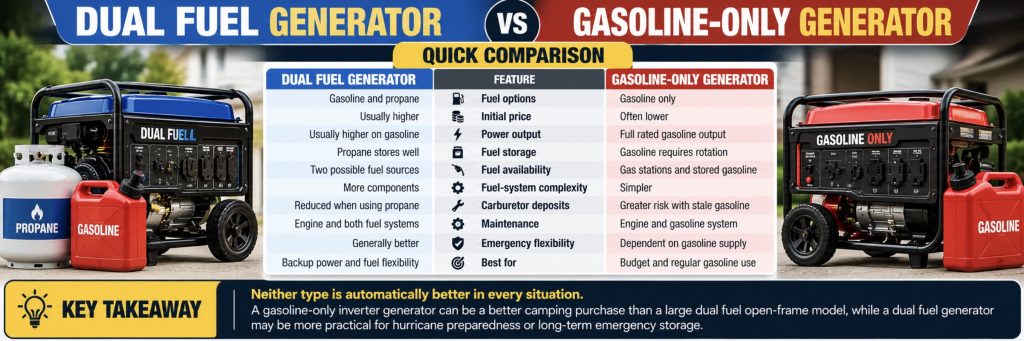
Dual Fuel vs Gas Generator: Quick Comparison
The main differences between dual fuel and gasoline-only generators become clearer when comparing their everyday advantages and limitations.
| Feature | Dual Fuel Generator | Gasoline-Only Generator |
|---|---|---|
| Fuel options | Gasoline and propane | Gasoline only |
| Initial price | Usually higher | Often lower |
| Power output | Usually higher on gasoline | Full rated gasoline output |
| Fuel storage | Propane stores well | Gasoline requires rotation |
| Fuel availability | Two possible fuel sources | Gas stations and stored gasoline |
| Fuel-system complexity | More components | Simpler |
| Carburetor deposits | Reduced when using propane | Greater risk with stale gasoline |
| Maintenance | Engine and both fuel systems | Engine and gasoline system |
| Emergency flexibility | Generally better | Dependent on gasoline supply |
| Best for | Backup power and fuel flexibility | Budget and regular gasoline use |
Neither type is automatically better in every situation. A gasoline-only inverter generator can be a better camping purchase than a large dual fuel open-frame model, while a dual fuel generator may be more practical for hurricane preparedness or long-term emergency storage.
1. Power Output: Which Generator Produces More Watts?
Gasoline generally provides higher maximum output than propane when both fuels are used in the same dual fuel generator.
This happens because gasoline and propane have different fuel characteristics, and the engine’s fuel system is calibrated accordingly.
For example, a dual fuel generator might produce:
- Gasoline: 6,250 running watts
- Propane: 5,600 running watts
These figures illustrate the output ratings of a particular class of dual fuel generator. Actual ratings vary by model.
The difference matters when powering equipment with high starting requirements, such as:
- Air conditioners
- Refrigerators
- Well pumps
- Sump pumps
- Air compressors
- Power tools
If a dual fuel generator produces 5,600 running watts on propane, you should calculate loads using that propane rating rather than its higher gasoline rating.
Winner: Gasoline for maximum output from the same dual fuel generator.
A gasoline-only generator may also provide better wattage per dollar, but that depends on the specific models being compared.
2. Fuel Availability During Power Outages
Fuel availability is one of the strongest reasons to consider a dual fuel generator.
During hurricanes, ice storms, wildfires, and widespread power outages, gasoline stations may lose electricity, close temporarily, or experience supply shortages.
A gasoline-only generator depends entirely on gasoline availability.
A dual fuel generator gives you another option if you have a properly stored propane supply.
For example, you may have:
- Several approved gasoline containers
- One or more propane cylinders
- A larger approved propane storage setup
If gasoline becomes unavailable, you can operate the generator on propane, provided the generator and fuel supply are correctly configured.
However, propane is not guaranteed to remain available during emergencies either. Both fuels can become difficult to obtain during major disasters.
Winner: Dual fuel generator.
Having two fuel options provides greater flexibility, especially during unpredictable emergencies.
3. Fuel Storage: Propane vs Gasoline
Fuel storage is another important difference.
Gasoline can deteriorate during prolonged storage. As volatile components evaporate and oxidation occurs, the fuel may become harder to ignite and leave deposits in the generator’s fuel system.
Ethanol-blended gasoline may also experience moisture-related storage problems under unfavorable conditions.
Propane behaves differently.
When stored correctly in an approved cylinder, propane remains stable for long periods and does not form the same gasoline varnish deposits inside a carburetor.
This makes propane particularly attractive for emergency generators that may sit unused for months.
Gasoline storage considerations:
- Requires approved fuel containers.
- Should be rotated according to storage recommendations.
- May benefit from a compatible fuel stabilizer.
- Can leave carburetor deposits if stored improperly.
- Must be kept away from ignition sources and living spaces.
Propane storage considerations:
- Requires properly maintained, approved cylinders.
- Cylinders must be stored according to local fire and safety regulations.
- Valves, regulators, and hoses require inspection.
- Cylinders must remain within applicable inspection and recertification requirements.
- Propane itself does not degrade like gasoline.
Winner: Dual fuel generator.
Propane gives dual fuel owners a convenient long-term fuel storage option.
4. Purchase Price: Which Is Cheaper?
Gasoline-only generators are often less expensive than comparable dual fuel models.
A dual fuel generator requires additional components, such as propane regulators, connections, hoses, and fuel-selection hardware.
Those extra components increase manufacturing complexity and can raise the purchase price.
However, the price difference varies considerably between brands and models.
A basic dual fuel generator may cost less than a premium gasoline-only inverter generator, so comparing only the fuel type can be misleading.
When shopping, compare:
- Rated running watts
- Starting watts
- Inverter or conventional alternator design
- Noise level
- Fuel tank capacity
- Electric start availability
- Outlets
- Warranty coverage
- Included accessories
If you are comparing products, browse dual fuel portable generators alongside gasoline-only portable generators with similar running wattage.

Westinghouse 4650 Peak Watt Dual Fuel Portable Generator, RV Ready 30A Outlet, Gas & Propane Powered, CO Sensor

Pulsar 2700 Watt Portable Inverter Generator, Dual Fuel Gasoline & Propane, CO Sensor, Super Quiet, Use for Jobsite, Camping, Outdoor & Home, NE27BISCO
DuroStar DS13000MX 13,000-Watt 500cc Dual Fuel Portable Generator - Gas and Propane, Remote Electric Start, Whole Home Power Backup, Transfer Switch Ready, RV & Emergency Ready
5. Running Costs: Is Gasoline or Propane Cheaper?
The cheapest fuel depends on local prices, generator efficiency, load level, and operating conditions.
Gasoline typically contains more energy per gallon than propane.
Approximate energy content:
- Gasoline: Around 114,000–116,000 BTU per US gallon, depending on formulation.
- Propane: Around 91,500 BTU per US gallon.
Because propane contains less energy per gallon, a generator may consume more gallons of propane than gasoline to produce comparable electrical energy.
However, propane may still be economical if its local price is sufficiently lower.
To compare running costs, use:
Hourly Fuel Cost = Fuel Consumption per Hour × Fuel Price per Unit
For example, if a generator consumes 0.5 gallons of gasoline per hour and gasoline costs $3.50 per gallon, the hourly fuel cost is $1.75.
If the same generator consumes 0.65 gallons of propane per hour and propane costs $2.50 per gallon, the hourly fuel cost is approximately $1.63.
These are hypothetical examples. Actual fuel consumption varies by generator, load, and fuel type.
Winner: Depends on local fuel prices and generator efficiency.
Gasoline may be more economical in some locations, while propane may be cheaper in others.
6. Runtime: Which Generator Runs Longer?
Runtime is determined by fuel quantity, electrical load, engine efficiency, and fuel type.
Gasoline generators usually have built-in tanks, while dual fuel generators can use an external propane cylinder.
A gasoline generator with a large fuel tank may run for many hours without refueling.
A dual fuel generator may run for an extended period on propane if connected to an appropriately sized cylinder or approved larger fuel supply.
However, propane runtime is not automatically longer.
For example:
- A generator with a large gasoline tank may run longer than the same model on a small propane cylinder.
- A generator connected to an appropriately sized larger propane supply may operate longer between fuel changes.
- Higher electrical loads reduce runtime on either fuel.
- Cold weather can reduce propane vaporization capacity from smaller cylinders.
When comparing manufacturer runtime claims, make sure the load percentage and fuel quantity are the same.
A gasoline runtime measured at 25% load should not be compared directly with propane runtime measured at 50% load.
Winner: Depends on fuel capacity and operating load.
Dual fuel models offer more options, but gasoline may provide longer runtime with certain tank configurations.
7. Maintenance: Which Is Easier to Maintain?
Both generator types require regular engine maintenance.
Common maintenance tasks include:
- Engine oil changes
- Air filter replacement
- Spark plug inspection
- Cooling system cleaning
- Battery maintenance on electric-start models
- Checking fuel lines and connections
- Inspecting electrical outlets and cords
Gasoline-only generators have simpler fuel systems, but stale gasoline can clog carburetor passages.
Dual fuel generators include additional propane components that need inspection.
These may include:
- Propane hose
- Regulator
- Fuel selector
- Propane inlet
- Seals and connections
Operating a dual fuel generator on propane can reduce gasoline-related deposits because propane does not leave the same varnish residue.
However, using propane does not eliminate oil changes, spark plug wear, air filter service, or general engine maintenance.
Winner: Gasoline-only for fuel-system simplicity; dual fuel when using propane to reduce gasoline storage problems.
8. Carburetor Problems and Long-Term Storage
Carburetor problems are especially common with generators that sit unused for months.
Gasoline remaining inside the carburetor can evaporate and leave sticky deposits.
These deposits may clog:
- Main jets
- Idle jets
- Fuel passages
- Float needle assemblies
- Emulsion tubes
A generator with a partially clogged carburetor may:
- Refuse to start
- Run only with the choke engaged
- Surge under load
- Start and immediately shut down
- Produce unstable engine speed
Propane avoids gasoline varnish formation while operating on that fuel.
For this reason, a dual fuel generator operated primarily on propane may be convenient for infrequent emergency use.
However, a dual fuel generator still requires gasoline-system maintenance if gasoline has been used or remains stored inside the tank and carburetor.
Winner: Dual fuel when propane is used appropriately.
9. Noise Level: Are Dual Fuel Generators Quieter?
A common misconception is that propane generators are always quieter than gasoline generators.
In reality, noise depends much more on generator construction, engine speed, load, exhaust design, and whether the generator uses inverter technology.
Important noise factors include:
- Open-frame versus enclosed design
- Inverter versus conventional generator
- Engine speed
- Electrical load
- Muffler design
- Distance from the generator
An enclosed inverter generator may be much quieter than a conventional open-frame generator regardless of fuel type.
Some dual fuel generators may sound slightly different when operating on propane, but this does not guarantee a significant noise reduction.
Winner: Neither.
Choose a quiet inverter model if noise is a major concern.
10. Environmental Impact and Emissions
Gasoline and propane are both combustible fuels that produce exhaust emissions.
Propane generally burns with lower particulate and certain pollutant emissions than gasoline in comparable small-engine applications, although actual emissions depend on engine design and operating conditions.
Potential propane advantages include:
- Lower tendency to produce soot
- Reduced gasoline-related evaporative emissions during use
- Cleaner fuel handling
- No gasoline spills when operating solely on propane
However, propane is still a fossil fuel and produces carbon dioxide and potentially dangerous carbon monoxide.
Important: Never operate a gasoline or propane generator indoors, inside a garage, in a shed, or near open windows and ventilation intakes.
Both fuels produce exhaust that can cause fatal carbon monoxide poisoning.
Winner: Propane for some emissions characteristics.
Neither type is safe for indoor operation.
11. Cold Weather Performance
Cold weather affects gasoline and propane generators differently.
Gasoline engines may be harder to start in cold conditions because of fuel vaporization, engine oil viscosity, battery condition, and other factors.
Propane remains usable in cold weather, but its ability to vaporize inside a cylinder declines as temperatures fall.
Small propane cylinders may struggle to supply sufficient vapor to a large generator under heavy load in extreme cold.
Cold-weather considerations include:
- Use manufacturer-recommended engine oil.
- Keep electric-start batteries fully charged.
- Use suitable propane cylinder sizes.
- Inspect propane regulators and hoses.
- Follow the manufacturer’s cold-start procedure.
Never attempt to warm a propane cylinder using an open flame or unauthorized heating device.
Winner: Depends on temperature, cylinder sizing, and generator design.
12. Reliability: Is Dual Fuel More Dependable?
Fuel type alone does not determine generator reliability.
A well-maintained gasoline-only generator can be extremely dependable, while a poorly maintained dual fuel generator may still fail during an outage.
Reliability depends on:
- Engine quality
- Maintenance history
- Fuel condition
- Starter system
- Electrical components
- Operating environment
- Load management
- Storage practices
Dual fuel generators provide a reliability advantage in one specific area: fuel flexibility.
If gasoline is unavailable, the generator may still operate on propane.
However, the additional propane equipment introduces more components that require inspection.
Winner: Dual fuel for fuel flexibility; overall mechanical reliability depends on the model.
13. Which Is Better for Home Backup Power?
For emergency home backup, a dual fuel generator often provides the most flexibility.
During a prolonged outage, it can be useful to have two fuel options available.
A dual fuel generator may power:
- Refrigerators and freezers
- Lighting circuits
- Internet equipment
- Phone chargers
- Fans
- Sump pumps
- Well pumps
- Selected household appliances
Gasoline-only generators are still a practical choice if you already maintain a reliable supply of fresh gasoline and want to minimize upfront cost.
For home backup, the most important considerations include output capacity, fuel supply, runtime, starting reliability, and safe connection to household circuits.
If you plan to connect a generator to your home’s electrical system, use a properly installed transfer switch or approved interlock system as required by local codes.
Never connect a portable generator to a household outlet to backfeed the electrical system.
Winner: Dual fuel for most emergency-preparedness buyers.
14. Which Is Better for Camping and RV Use?
Camping and RV buyers have different priorities from homeowners preparing for outages.
Portability, noise, fuel availability, and electrical output are often more important than maximum backup capacity.
Gasoline-only inverter generators can be attractive because they are compact, lightweight, and relatively straightforward to operate.
Dual fuel inverter generators offer additional flexibility.
Propane may be particularly convenient for RV owners who already carry propane for cooking, heating, or other equipment.
However, an RV propane system must be compatible with the generator’s fuel requirements. Do not assume the generator can be connected directly to any RV propane outlet without the proper regulator configuration and manufacturer approval.
Choose dual fuel for RV use if:
- You already carry propane.
- You prefer long-term propane storage.
- You want a second fuel option.
- You occasionally use the generator for home backup.
Choose gasoline-only for camping if:
- You want a simple portable generator.
- You use the generator frequently.
- You prefer a compact inverter model.
- You do not want additional propane equipment.
Winner: Depends on camping style and fuel availability.
15. Which Is Better for Construction and Jobsites?
Construction sites often require generators to operate power tools, compressors, lighting equipment, and other heavy electrical loads.
Gasoline-only generators can be attractive because:
- They are commonly available.
- They may cost less.
- They can deliver strong rated output.
- Gasoline is familiar to many equipment operators.
Dual fuel generators offer flexibility when gasoline availability is uncertain or propane is already part of the jobsite fuel supply.
However, operators must compare the generator’s propane output rating with the startup requirements of equipment.
Winner: Gasoline-only for simplicity and value; dual fuel for flexible fuel logistics.
16. Popular Dual Fuel Generator Brands
Several manufacturers offer dual fuel portable generators across different power categories.
Champion
Champion offers compact inverter generators, open-frame portable generators, and larger backup-oriented dual fuel models. Many models include fuel-selection controls designed to simplify changing between gasoline and propane.
Westinghouse
Westinghouse offers dual fuel generators for RV use, camping, and home backup. Some models feature electric start, remote start, or higher-output receptacles.
For additional model information, see Westinghouse Generator Reviews (Dual Fuel, Inverter, Standby).
DuroMax
DuroMax is well known for larger portable generators, including dual fuel options suitable for powering selected household circuits during outages.
Firman
Firman offers several dual fuel and multi-fuel portable generators designed for outdoor work, recreation, and backup power.
WEN
WEN offers portable generators and inverter models, including certain dual fuel configurations.
Before choosing a brand, compare individual model specifications rather than assuming every generator from one manufacturer performs the same way.
Top Dual Fuel and Gasoline Generators Worth Considering
If you have decided which fuel type is more practical for your needs, the next step is choosing a specific generator. The following models offer different combinations of power output, portability, inverter technology, and home-backup capability. These are specification-based buying overviews rather than claims of hands-on testing. Model availability and prices can change, so confirm the exact product version before ordering.
Best Dual Fuel Generators
1. Champion 4000-Watt Dual Fuel Inverter (Model 201050) – Best for RVs and Portable Use
The Champion 201050 is a strong option for campers and RV owners who want inverter-generated electricity without giving up propane flexibility. It delivers 4,000 starting watts and 3,000 running watts on gasoline, or 4,000 starting watts and 2,700 running watts on propane. Its RV-ready TT-30R receptacle and relatively compact size make it more suitable for recreational use than a large open-frame home-backup generator.
- Fuel: Gasoline or propane
- Rated power: 3,000 running watts on gasoline; 2,700 on propane
- Best for: RVs, camping, tailgating, and a few essential appliances
- Pros: Dual fuel capability, inverter output, RV outlet, portable construction, parallel-ready design
- Cons: Lower propane output and insufficient capacity for major household loads or 240V appliances
Our take:
This is an appealing middle-ground choice when portability and fuel flexibility matter more than maximum wattage. Check the Champion 201050 dual fuel inverter generator on Amazon.
2. Westinghouse WGen9500DF – Best for High-Output Home Backup
The Westinghouse WGen9500DF is designed for larger backup loads. It is rated for 9,500 running watts on gasoline or 8,500 running watts on propane, with 12,500 and 11,200 peak watts respectively. Electric and remote starting, 120/240V output connections, and a wheeled frame make it practical for homeowners who need significantly more output than a compact inverter can provide.
- Fuel: Gasoline or propane
- Rated power: 9,500 running watts on gasoline; 8,500 on propane
- Best for: Emergency home backup and larger portable loads
- Pros: High wattage, remote/electric start, 120/240V connections, propane flexibility
- Cons: Heavy open-frame design, relatively loud operation, and not suitable for transporting by hand
Our take:
Choose this type of generator when power capacity matters more than portability or quiet operation. Household circuits require code-compliant transfer equipment installed by a qualified professional. Compare Westinghouse WGen9500DF listings on Amazon.
3. Champion 4500-Watt Dual Fuel Inverter (Model 201531) – Best for a Compact Enclosed Dual Fuel Setup
The Champion 201531 combines an enclosed inverter design with gasoline and propane operation. It produces 4,500 starting watts, 3,250 running watts on gasoline, and 2,925 running watts on propane. Its covered outlets include an RV-style TT-30R receptacle. It is a practical choice for buyers who want a smaller dual fuel unit for recreation or selected backup essentials.
- Fuel: Gasoline or propane
- Rated power: 3,250 running watts on gasoline; 2,925 on propane
- Best for: Camping, RV equipment, and selected household essentials
- Pros: Enclosed inverter design, dual fuel capability, RV receptacle, parallel-ready design
- Cons: Recoil-start configuration and limited wattage compared with larger backup generators
Our take:
It is worth comparing against the smaller Champion 201050 based on dimensions, output, and local pricing rather than relying on the starting-watt figure alone. See Champion 201531 generator listings on Amazon.
Best Gasoline-Only Generators
4. Honda EU2200i – Best for Quiet, Premium Portable Power
Honda’s EU2200i is a compact gasoline inverter generator rated for 2,200 maximum watts and 1,800 running watts. Honda lists noise levels of approximately 48 dB(A) at one-quarter load and 57 dB(A) at rated load, making it particularly appealing for recreation and situations where generator noise is a concern.
- Fuel: Gasoline only
- Rated power: 1,800 running watts; 2,200 maximum watts
- Best for: Camping, small electronics, and light essential loads
- Pros: Quiet inverter design, compact size, strong brand service reputation, clean output
- Cons: Premium pricing and insufficient output for multiple large appliances
Our take:
The EU2200i makes sense when refined operation matters more than watts per dollar. Find Honda EU2200i generator listings on Amazon.
5. Champion 4000-Watt Gasoline Inverter (Model 100809) – Best for Mid-Range Gasoline Inverter Value
Champion’s 100809 provides 4,000 starting watts and 3,000 running watts on gasoline, with an RV-style 120V TT-30R connection and inverter output suitable for many common electronics. It weighs under 49 pounds and is a practical alternative for buyers who do not need a propane hookup.
- Fuel: Gasoline only
- Rated power: 3,000 running watts; 4,000 starting watts
- Best for: RVs, camping, and a modest set of electrical loads
- Pros: Relatively lightweight, inverter design, RV receptacle, no propane equipment to manage
- Cons: Only one fuel source and not designed for large multi-circuit home backup
Our take:
Buyers comparing Champion’s gasoline and dual fuel inverters should weigh the additional fuel flexibility against the purchase-price difference. Look up the Champion 100809 inverter on Amazon.
6. Westinghouse WGen7500 – Best Gasoline-Only Option for Larger Backup Loads
The Westinghouse WGen7500 is a conventional gasoline portable generator with a rated output of 7,500 running watts and 9,500 peak watts. Its 120/240V output and electric-start features make it an option for buyers who need larger backup capacity but prefer not to maintain propane connections.
- Fuel: Gasoline only
- Rated power: 7,500 running watts; 9,500 peak watts
- Best for: Emergency backup, tools, and higher-wattage portable loads
- Pros: Strong output, 120/240V capability, familiar gasoline operation
- Cons: Larger and louder than compact inverters, no alternate fuel source
Our take:
This is a suitable category of machine if you value output capacity and simplicity, while the dual fuel WGen9500DF is better suited to buyers who also want propane flexibility. Check Westinghouse WGen7500 listings on Amazon.
Which of These Generators Should You Buy?
- For flexible RV and camping use: Champion 4000-Watt Dual Fuel Inverter 201050
- For larger dual fuel home backup: Westinghouse WGen9500DF
- For a compact enclosed dual fuel inverter: Champion 4500-Watt 201531
- For premium quiet gasoline power: Honda EU2200i
- For gasoline inverter value: Champion 4000-Watt 100809
- For higher-output gasoline backup: Westinghouse WGen7500
Before making a purchase, verify the model number, available fuel type, outlet configuration, and rated running watts. The Amazon links above are search pages, so listings may include related models or accessories. Also remember that even generators with carbon monoxide shutoff technology must only be operated outdoors, far from doors, windows, and air intakes.
17. Choosing the Right Generator Size
Regardless of fuel type, buying the correct generator size is essential.
A generator that is too small may repeatedly overload, shut down, or fail to start motor-driven appliances.
A generator that is much larger than necessary may consume more fuel and cost more upfront.
Start by listing the appliances you plan to power.
For example:
- Refrigerator: 200 running watts
- Freezer: 150 running watts
- Lighting: 100 watts
- Internet router: 20 watts
- Fans: 150 watts
- Phone chargers: 30 watts
The estimated combined running load is 650 watts.
However, refrigerator and freezer compressors may require additional starting watts.
The generator must be able to handle the combined running load plus the largest expected additional startup surge, accounting for simultaneous motor starts when applicable.
These example wattages are illustrative. Actual appliance requirements vary.
For a dual fuel generator, perform the calculation against both the gasoline and propane ratings.
18. Accessories Worth Considering
Whichever generator type you choose, the right accessories can improve convenience and safety.
Useful accessories include:
- Approved gasoline containers
- Fuel stabilizer
- Compatible propane cylinders
- Manufacturer-approved propane hoses and regulators
- Heavy-duty generator extension cords
- Generator running covers designed for ventilation
- Battery maintainers for electric-start models
- Carbon monoxide alarms
- Appropriate transfer equipment
If you use gasoline regularly, a generator fuel stabilizer may help reduce storage-related fuel deterioration.
For propane operation, use a dual fuel generator propane hose and regulator specifically approved for your generator model.
A properly rated heavy-duty generator extension cord is also important for safely supplying appliances.

BILT HARD 5500W Dual Fuel Inverter Generator, Gasoline/LPG | 4000W gas/3600W LPG Running Power, 160cc OHV Engine, Co Auto-Shutoff, Eco Mode and Parallel-Ready Design

WEN Quiet and Lightweight 4800-Watt Dual Fuel RV-Ready Electric Start Portable Inverter Generator with Fuel Shut Off and CO Watchdog (DF480iX)

ERAYAK 4500W Dual-Fuel Portable Inverter Generator for Home Use, Camping Outdoor, 30A RV Ready, Auto Switch, Gas and Propane Powered, EPA, CO Sensor, Parallel Ready, Campact Design
19. Common Mistakes When Choosing Between Dual Fuel and Gasoline
Several purchasing mistakes can make either generator type disappointing.
Comparing Starting Watts Instead of Running Watts
Generator marketing often emphasizes starting watts. Always compare continuous output and account for motor startup requirements.
Ignoring the Lower Propane Output
Many dual fuel generators produce fewer watts on propane. Check both ratings before purchasing.
Assuming Propane Is Always Cheaper
Fuel costs depend on local prices and generator consumption.
Ignoring Fuel Storage
Gasoline-only generators need a sensible fuel rotation and storage plan. Propane cylinders also require appropriate storage and inspection.
Buying Based on Brand Alone
Individual models vary in features, output, noise, efficiency, and warranty coverage.
Overlooking Fuel-System Maintenance
Dual fuel generators still require maintenance even when operated primarily on propane.
Assuming Dual Fuel Means Simultaneous Fuel Use
Most gasoline-propane dual fuel generators operate on one fuel at a time. Do not attempt to feed both fuels simultaneously unless the manufacturer explicitly designs the system for that operation.
20. Final Buying Advice: Which One Should You Choose?
If you are buying a generator primarily for emergencies, dual fuel is often worth considering.
The ability to store propane and switch between two fuel sources provides extra flexibility when gasoline is unavailable.
Dual fuel is especially attractive when:
- You want emergency backup power.
- You expect long storage periods.
- You already own propane cylinders.
- You want flexibility during fuel shortages.
- You use the generator for both camping and home backup.
Gasoline-only generators remain excellent choices when:
- You want the lowest reasonable purchase price.
- You use the generator frequently.
- You prefer a simpler fuel system.
- Gasoline is readily available.
- You want maximum output without paying extra for dual fuel capability.
If you are choosing between specific models, compare power output, fuel consumption, maintenance requirements, portability, noise, and included accessories rather than deciding on fuel type alone.
Frequently Asked Questions
Is a dual fuel generator better than a gas generator?
A dual fuel generator is generally better for fuel flexibility and emergency storage, while a gasoline-only generator may offer lower purchase costs and simpler operation. The best option depends on your needs.
Do dual fuel generators produce less power on propane?
Many do. Propane running watts are commonly lower than gasoline running watts on the same generator. Always check the specific manufacturer’s ratings.
Can a dual fuel generator run on gasoline and propane at the same time?
Most consumer dual fuel generators are designed to operate on one fuel at a time. Follow the manufacturer’s instructions for fuel switching.
Is propane cheaper than gasoline for generators?
It depends on local fuel prices and the generator’s consumption rate. Propane can be more or less economical depending on the operating conditions.
Does propane make a generator last longer?
Using propane can reduce gasoline-related carburetor deposits, but overall engine lifespan depends on maintenance, loading, temperature, oil condition, and construction quality.
Can I convert my gas generator to dual fuel?
Some gasoline generators can be converted using compatible conversion systems. However, modifications may affect emissions compliance, warranty coverage, fuel safety, and performance. Use only manufacturer-approved or properly certified solutions.
Are dual fuel generators harder to maintain?
They have additional propane components to inspect, but routine engine maintenance is generally similar to gasoline-only generators.
How long can propane be stored for generator use?
Propane remains chemically stable during long-term storage when kept in an approved, properly maintained cylinder. Cylinder inspection and storage requirements still apply.
Is a dual fuel generator better for hurricanes?
It can be a practical choice because gasoline and propane provide two fuel options. Fuel storage and safe outdoor operating arrangements are still essential.
Can I use a dual fuel generator for my RV?
Yes, provided the generator has appropriate electrical output, receptacles, and fuel connections for your RV setup.
Are propane generators quieter than gasoline generators?
Not necessarily. Noise depends more on generator design, engine speed, load, and enclosure than fuel type alone.
What happens if my dual fuel generator runs out of propane?
The generator will typically stop unless it supports an approved operating fuel-switch procedure and you switch according to the instructions. Do not assume automatic fuel switching is provided.
Do dual fuel generators need gasoline in the tank?
Many dual fuel generators can operate entirely on propane without gasoline in the tank. Always follow the manufacturer’s starting and operating instructions.
Which fuel is better for long-term generator storage?
Propane is often more convenient because it does not degrade like gasoline. However, both the generator and fuel cylinders still require regular inspection.
Which is better for sensitive electronics?
Fuel type does not determine power quality. A properly designed inverter generator is generally the more important consideration when powering sensitive electronics.
Safety Tips for Gasoline and Propane Generators
Both generator types require careful operation.
Follow these essential precautions:
- Operate the generator outdoors only.
- Keep it far away from windows, doors, vents, and air intakes.
- Direct exhaust away from occupied buildings.
- Use carbon monoxide alarms inside nearby buildings.
- Never refuel a hot or running generator.
- Inspect propane hoses and connections for leaks using approved methods.
- Never check propane leaks with an open flame.
- Use correctly rated extension cords.
- Keep fuel containers away from ignition sources.
- Use professionally installed transfer equipment when connecting the generator to household circuits.
A generator with carbon monoxide shutdown protection still must be operated outdoors. That feature is not a substitute for safe placement.
Summary
Dual fuel and gasoline-only generators each offer advantages. Dual fuel generators provide the flexibility to operate on gasoline or propane, making them particularly attractive for emergency backup power, long-term fuel storage, RV use, and households that want multiple fuel options.
Gasoline-only generators often cost less, have simpler fuel systems, and can provide strong power output without the additional propane components. They remain practical choices for frequent users, jobsites, and buyers focused on affordability.
For most homeowners purchasing a portable generator primarily for emergency preparedness, a dual fuel model is often the more versatile investment. However, a gasoline-only generator can be the better purchase when budget, simplicity, or a particular model’s performance matters more than fuel flexibility.
The best generator is ultimately the one that delivers enough running and starting watts, uses fuel you can obtain and store safely, fits your budget, and can be maintained reliably for years.
Savior Generator Petcock Gas Fuel Tank Shut Off Valve for Champion Generac | 0j0974,Switch,Predator Etq Homelite Husky Powermax,(16mm x 1.5mm)

Generac 5W-20 Maintenance Kit for 20Kw-26Kw 999cc Generators (Replaces A0002074712)

Pull Start Assembly with Start Cup Compatible with Honda GX120 GX160 GX200 | Recoil Starter Compatible with 28400-ZE1-003ZF 28400-ZH8-013YA Pull Starter Engine 4/5.5/6.5hp Motor (2 PACK)

YGQ Generator Fuel Shut Off Valve for Predator 4000 6500 Generac 0J0974 | M16x1.5mm fuel Petcock for Honda Centurion Duromax Powermate Powerhorse ETQ Gas Tank

GNA410 Generator Wheel and Handle Kit for W-EN 4500 and 4750-Watt Generators, Compatible with W-EN DF475T, DF475, GN4500, DF472, DF475X, DF472X
About GeneratorStop.com
We are your #1 power generator guide and resource online. We are dedicated on providing you the best and most useful generator related articles, reviews and tools. learn more...