


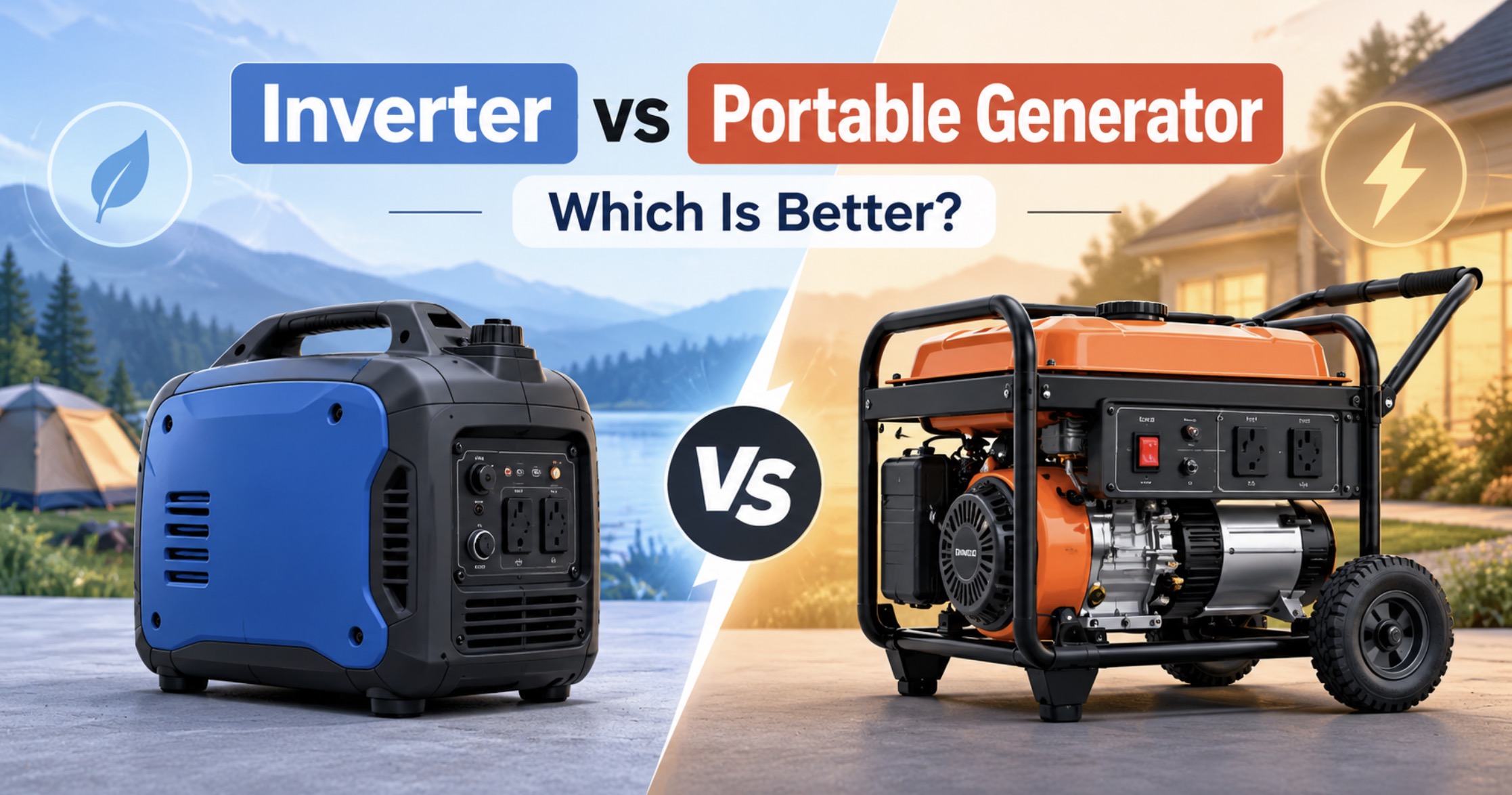
Inverter vs Portable Generator: Which Is Better?
* This site contains affiliate links for which we may be compensated.
When shopping for a generator, one of the most common questions is whether an inverter generator or a traditional portable generator is the better choice. Both types can provide electricity during power outages, camping trips, RV adventures, construction projects, and outdoor events. However, they differ significantly in noise levels, fuel efficiency, electrical output, portability, power quality, maintenance requirements, and overall cost. Choosing the wrong type could mean spending more than necessary, dealing with excessive noise, or purchasing a generator that cannot handle your electrical needs.
Inverter generators are generally known for quieter operation, cleaner electrical output, better fuel efficiency at lighter loads, and compact designs. Traditional portable generators, often called conventional generators, are usually associated with higher power output, larger fuel tanks, lower cost per watt, and practical performance for home backup or demanding jobsites.
However, there is an important distinction: inverter generators are also portable generators. When people compare “inverter vs portable generator,” they usually mean an inverter generator versus a conventional portable generator that uses a traditional alternator.
Neither technology is automatically better for every situation. A small inverter generator may be ideal for camping and powering electronics, while a large conventional generator may be more practical for running refrigerators, pumps, air conditioners, and multiple household circuits during an outage.
Before purchasing either type, it helps to determine your electrical requirements. The Generator Load Calculation Sheet and Formula explains how to estimate running watts, starting watts, and the generator capacity needed for different appliances.
What Is an Inverter Generator?
An inverter generator is a generator that uses electronic power conversion to produce regulated alternating-current electricity.
In most inverter-generator designs, the engine drives an alternator that produces electricity. This electricity is then converted and processed by an electronic inverter system to deliver the required AC output.
Unlike many conventional generators, inverter models can adjust engine speed according to electrical demand rather than operating continuously at one fixed engine speed.
Common inverter generator features include:
- Electronic inverter technology
- Relatively stable voltage and frequency output
- Low total harmonic distortion on many models
- Variable engine speed
- Economy or eco-throttle mode
- Quiet enclosed designs on many compact models
- Compact and lightweight construction
- Parallel capability on selected models
- Automatic overload protection
Inverter generators are particularly popular for camping, RVs, outdoor recreation, mobile workstations, and powering electronic devices.
However, inverter technology is not limited to small generators. Larger open-frame and enclosed inverter models are also available for home backup and more demanding applications.

Oxseryn Power Equipment 4400 Watts Inverter Generator Gas Powered, Portable Open Frame Generator, Low Noise with ECO Mode, RV Ready, Emergency Home Backup

WEN Quiet and Lightweight 4800-Watt Dual Fuel RV-Ready Electric Start Portable Inverter Generator with Fuel Shut Off and CO Watchdog (DF480iX)

WEN 6800-Watt Dual Fuel RV-Ready Electric Start Portable Inverter Generator with Fuel Shut Off and CO Watchdog for Electric Vehicle Backup (DF680iX)
What Is a Conventional Portable Generator?
A conventional portable generator uses an engine to drive an alternator that produces electrical power directly.
Most conventional portable generators regulate voltage through an automatic voltage regulator, capacitor-based system, or another alternator-specific regulation method.
The engine generally operates near a fixed speed to maintain the required AC frequency.
For many North American conventional generators producing 60Hz electricity, this is approximately 3,600 RPM on common two-pole alternator designs. Other alternator configurations may operate at different speeds.
Conventional portable generators commonly include:
- Gasoline, propane, diesel, or multi-fuel engine options
- Open-frame construction
- Traditional alternator design
- Circuit breaker protection
- Automatic voltage regulation on many models
- Larger fuel tanks on higher-output units
- 120V and sometimes 120/240V outlets
- Electric start on selected models
- Wheel kits and transport handles
Traditional portable generators remain popular for emergency home backup, construction sites, workshops, farms, and applications requiring substantial electrical output.
A conventional portable generator can be a practical purchase when wattage and purchase price matter more than noise, compactness, or inverter-grade electrical output.
AIVOLT 1750W Inverter Generator Portable Gas Generator for Camping Home | Ultra-Light 26.5lbs, One-Hand Carry. Super Quiet 52dBA. Clean <3% THD Power. CO Auto-Shutoff. 7hr ECO Mode. EPA Compliant.

DuroStar DS13000MX 13,000-Watt 500cc Dual Fuel Portable Generator - Gas and Propane, Remote Electric Start, Whole Home Power Backup, Transfer Switch Ready, RV & Emergency Ready

Westinghouse 4650 Peak Watt Dual Fuel Portable Generator, RV Ready 30A Outlet, Gas & Propane Powered, CO Sensor
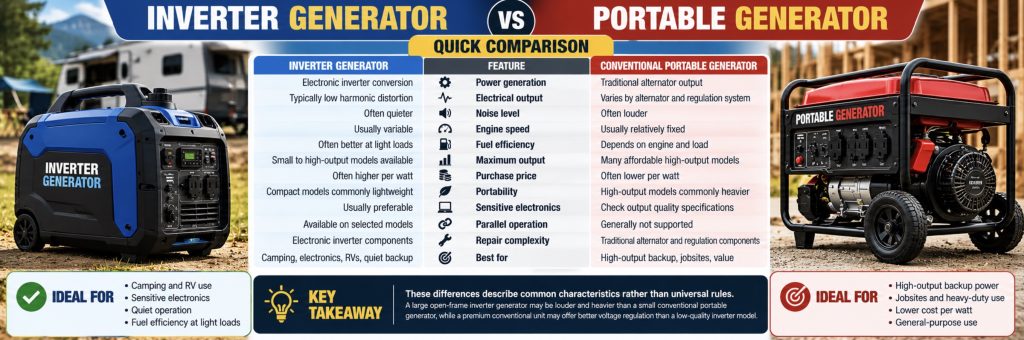
Inverter vs Portable Generator: Quick Comparison
The main differences become easier to understand when comparing the two generator technologies side by side.
| Feature | Inverter Generator | Conventional Portable Generator |
|---|---|---|
| Power generation | Electronic inverter conversion | Traditional alternator output |
| Electrical output | Typically low harmonic distortion | Varies by alternator and regulation system |
| Noise level | Often quieter | Often louder |
| Engine speed | Usually variable | Usually relatively fixed |
| Fuel efficiency | Often better at light loads | Depends on engine and load |
| Maximum output | Small to high-output models available | Many affordable high-output models |
| Purchase price | Often higher per watt | Often lower per watt |
| Portability | Compact models commonly lightweight | High-output models commonly heavier |
| Sensitive electronics | Usually preferable | Check output quality specifications |
| Parallel operation | Available on selected models | Generally not supported |
| Repair complexity | Electronic inverter components | Traditional alternator and regulation components |
| Best for | Camping, electronics, RVs, quiet backup | High-output backup, jobsites, value |
These differences describe common characteristics rather than universal rules. A large open-frame inverter generator may be louder and heavier than a small conventional portable generator, while a premium conventional unit may offer better voltage regulation than a low-quality inverter model.
1. Power Output: Which Generator Produces More Electricity?
Power output is one of the biggest considerations when choosing between inverter and conventional portable generators.
Traditional portable generators have historically been popular for higher-output applications because they can deliver substantial wattage at relatively affordable prices.
Common conventional generator categories include:
- 3,000–4,000-watt portable generators
- 5,000–7,500-watt backup generators
- 8,000–10,000-watt portable generators
- 12,000-watt and larger high-output models
Inverter generators are available in many of these output categories, but compact inverter models usually offer less capacity than large conventional units.
For example:
- A compact inverter generator may provide 1,800 running watts.
- A mid-sized inverter generator may provide 3,000–5,000 running watts.
- A larger inverter generator may provide significantly more power.
- A high-output conventional portable generator may provide 7,500–10,000 running watts or more.
Both generator types must be evaluated using running watts and starting watts.
Running watts represent the generator’s continuous output capacity.
Starting watts describe its ability to handle temporary startup demand from appliances with electric motors.
Winner: Conventional portable generators for affordable high-output capacity.
Inverter generators can also provide substantial power, but conventional models frequently deliver more watts per dollar.
2. Noise Level: Which Generator Is Quieter?
Noise is one of the most noticeable differences between compact inverter generators and traditional open-frame generators.
Many inverter models use enclosed housings, insulated panels, efficient mufflers, and variable-speed engines to reduce operating noise.
Conventional portable generators often use open-frame construction and engines operating near a fixed speed.
For comparison, manufacturer specifications for selected models include:
- Honda EU2200i: Approximately 48 dB(A) at one-quarter load and 57 dB(A) at rated load.
- Champion 4000W Inverter Model 100809: Approximately 64 dB(A) measured from 23 feet.
- Westinghouse WGen7500: Approximately 72 dB(A), according to manufacturer specifications.
- Champion 9200W Conventional Model 201494: Approximately 74 dB(A) measured from 23 feet.
Noise ratings should be compared carefully because manufacturers may use different testing distances, loads, and procedures.
In practical use, quieter generators are especially valuable when:
- Camping near other people
- Using a generator at an RV campground
- Operating near outdoor seating areas
- Powering equipment for long periods
- Working in noise-sensitive environments
A quiet inverter generator can provide a more comfortable experience than a large open-frame conventional unit.
However, inverter technology alone does not guarantee quiet operation.
Winner: Inverter generators.
Compact enclosed inverter models are generally better when low noise is a priority.
3. Fuel Efficiency: Which Generator Uses Less Gasoline?
Many inverter generators can adjust engine speed automatically based on connected electrical demand.
When powering only a small load, the engine may slow down, reducing fuel consumption and noise.
Traditional portable generators usually maintain a relatively constant engine speed to preserve the required output frequency.
For example, if you are charging phones, powering a router, and running a small fan, an inverter generator may operate at a lower engine speed than it would under heavy load.
This can improve fuel efficiency.
However, actual fuel consumption depends on:
- Generator size
- Engine design
- Electrical load
- Fuel type
- Operating temperature
- Generator maintenance
- Engine speed management
A small conventional generator may consume less fuel than a much larger inverter generator when powering the same equipment.
That is why buyers should compare actual fuel consumption per hour at similar electrical loads.
Winner: Inverter generators for many light-load applications.
At higher loads, the efficiency difference depends on the specific models being compared.
4. Power Quality: Which Is Better for Sensitive Electronics?
One of the strongest advantages of inverter generators is their ability to produce relatively stable AC electricity with low harmonic distortion.
Electronic devices often rely on power supplies designed to operate within specified voltage and frequency limits.
Equipment that may benefit from good electrical output quality includes:
- Laptops
- Desktop computers
- Televisions
- Gaming consoles
- Networking equipment
- Battery chargers
- Audio equipment
- Some specialized electronic instruments
Many inverter generators advertise total harmonic distortion below 3%.
Conventional portable generators may produce higher harmonic distortion, although actual performance varies.
Some conventional generators also include advanced voltage regulation and can power a broad range of modern electronics.
Electrical compatibility should always be checked against the connected equipment’s specifications.
A device is not automatically unsafe on conventional generator power, and low total harmonic distortion does not guarantee protection against every electrical problem.
Winner: Inverter generators.
They generally offer an advantage for buyers prioritizing low-distortion, electronically regulated electricity.
5. Purchase Price: Which Is More Affordable?
Inverter generators often cost more per rated watt than conventional generators.
The electronic inverter module, variable-speed controls, noise-reduction features, and other components contribute to the price difference.
A conventional generator may offer higher wattage at a lower purchase price, especially in the 5,000–10,000-watt range.
However, price comparisons should account for more than power output.
Important features include:
- Running and starting watts
- Noise level
- Fuel efficiency
- Electric start
- Fuel capacity
- Warranty
- Outlet configuration
- Weight
- Power quality
A small premium inverter generator can cost more than a larger conventional generator, but that does not necessarily make the conventional unit better for camping or electronic equipment.
Winner: Conventional portable generators.
They frequently provide stronger wattage value for buyers who prioritize initial cost.
6. Portability: Which Is Easier to Transport?
Compact inverter generators are often designed for portability.
Many feature carrying handles, enclosed cases, and relatively low weight.
For example, the Honda EU2200i weighs approximately 47.4 pounds dry, while the Champion 100809 weighs approximately 48.1 pounds.
Larger conventional generators can weigh well over 100 pounds and may require wheels and handles for movement.
Portable generator features worth comparing include:
- Dry weight
- Dimensions
- Carrying handles
- Wheel kit availability
- Fuel tank capacity
- Storage requirements
- Ease of loading into a vehicle
A lightweight inverter generator is often more convenient for camping and outdoor recreation.
However, large inverter generators can also be heavy.
Winner: Compact inverter generators.
They generally offer better portability in lower-output categories.
7. Runtime: Which Generator Runs Longer?
Runtime depends on fuel capacity, generator efficiency, and electrical demand.
Compact inverter generators often have relatively small fuel tanks, but their efficient operation under light loads can provide useful runtime.
Conventional portable generators frequently have larger tanks that allow extended operation.
For example:
- Honda EU2200i: Up to approximately 8.1 hours at one-quarter load.
- Champion 100809: Up to approximately 10 hours at one-quarter load.
- Champion 100519: Up to approximately 13.5 hours at one-quarter load.
- Westinghouse WGen7500: Up to approximately 11 hours at one-quarter load.
These figures come from manufacturer specifications and involve different generator sizes and tank capacities.
They should not be treated as identical operating conditions.
When comparing runtime, calculate the amount of usable electricity produced per quantity of fuel rather than comparing runtime alone.
Winner: Depends on generator size, tank capacity, and operating load.
8. Maintenance: Which Generator Is Easier to Maintain?
Both inverter and conventional generators require routine engine maintenance.
Common service items include:
- Engine oil
- Air filter
- Spark plug
- Fuel system
- Starter battery when equipped
- Cooling system
- Electrical connections
Conventional generators may have components such as automatic voltage regulators, rotor brushes, and traditional alternator windings.
Inverter generators include additional electronic power-conversion components.
These differences become important when repairs are necessary.
Conventional generator maintenance advantages:
- Traditional alternator components may be easier to diagnose.
- Some repairs involve replaceable AVRs or carbon brushes.
- Basic open-frame designs often provide easier physical access.
Inverter generator maintenance considerations:
- Electronic inverter modules can be expensive.
- Some models require removal of enclosed panels for servicing.
- Electrical diagnosis may require model-specific procedures.
For troubleshooting and replacement parts, see Generator Parts and Repairs.
Winner: Conventional generators for potentially simpler alternator repairs.
Routine engine maintenance is broadly similar between the two types.
9. Reliability and Generator Lifespan
Neither inverter technology nor conventional alternator construction automatically guarantees longer service life.
Generator reliability depends on:
- Engine quality
- Manufacturing quality
- Maintenance
- Operating load
- Storage conditions
- Fuel quality
- Cooling and ventilation
- Availability of replacement parts
A high-quality inverter generator can provide many years of dependable service.
Similarly, a well-maintained conventional generator may operate reliably for years when used within its electrical limits.
Repeated overloading, poor oil maintenance, moisture exposure, and stale fuel can damage either type.
Winner: Neither.
Choose a well-supported model and maintain it according to the manufacturer’s instructions.
10. Starting Watts and Motor-Driven Appliances
Appliances with motors often require more power when starting than during normal operation.
Examples include:
- Refrigerators
- Freezers
- Sump pumps
- Well pumps
- Air conditioners
- Air compressors
- Power tools
A generator must provide enough running watts for connected equipment and sufficient surge capacity for startup demand.
Some inverter generators have electronic overload protection that quickly shuts off output when the power demand exceeds their limits.
Conventional generators may use circuit breakers and voltage regulation to respond to overloads.
If your generator repeatedly displays an overload warning, read Generator Overload Light On? Here’s What It Means.
Winner: Depends on rated starting capacity.
A larger conventional generator often handles demanding motors more economically, but a suitably sized inverter can also perform well.
11. Parallel Capability: Can You Connect Two Generators?
Some inverter generators support parallel operation.
Parallel capability allows two compatible generator units to connect through a manufacturer-approved parallel kit.
This can increase available electrical output without requiring a single larger generator.
For example, two compatible 2,000-watt-class inverter generators may provide significantly more combined power than either unit alone.
Potential advantages include:
- More flexible power capacity
- Transporting two smaller units instead of one large unit
- Running one generator when electrical demand is low
- Additional output when both generators are needed
However, not all inverter generators support parallel operation.
Parallel kits are often brand- and model-specific.
Never connect two generator outputs together using ordinary extension cords or improvised wiring.
Winner: Inverter generators with manufacturer-approved parallel capability.
12. Fuel Options: Gasoline, Propane, and Dual Fuel
Inverter and conventional generators are available with different fuel systems.
Common options include:
- Gasoline-only inverter generators
- Dual fuel inverter generators
- Gasoline-only conventional generators
- Dual fuel conventional generators
- Tri-fuel conventional generators
- Selected multi-fuel inverter models
Fuel type is separate from generator technology.
A dual fuel inverter generator combines electronic inverter power conversion with gasoline and propane capability.
A conventional dual fuel generator uses a traditional alternator but can operate on gasoline and propane.
When choosing fuel type, consider:
- Fuel availability
- Storage requirements
- Operating cost
- Fuel consumption
- Emergency backup needs
Winner: Neither.
Both generator technologies offer different fuel options depending on the model.
13. Which Is Better for Home Backup Power?
For emergency home backup, the best choice depends on how much electricity your household needs.
A compact inverter generator can power selected essentials, such as:
- Internet router
- Phone chargers
- Lights
- Television
- Small fans
- One refrigerator if starting requirements are within capacity
Larger conventional generators are often better suited for running multiple appliances and larger motor-driven loads.
A high-output conventional generator may support:
- Multiple refrigerators or freezers
- Sump pumps
- Well pumps
- Furnace blowers
- Selected air-conditioning equipment
- Additional household circuits
However, large inverter generators are increasingly available for backup applications as well.
If you want quiet emergency power for selected essentials, an inverter generator may be preferable.
If your priority is maximum watts per dollar, a conventional portable generator often makes more sense.
Winner: Conventional portable generators for budget-conscious high-output backup; inverter generators for quieter essential-load backup.
14. Which Is Better for Camping?
Camping is one of the areas where inverter generators have a major advantage.
Many camping situations require relatively modest electrical output.
Common camping loads include:
- Phone chargers
- Portable refrigerators
- Lighting
- Small cooking appliances
- Fans
- Battery chargers
- Portable electronics
A compact inverter generator can provide these loads without the excessive noise and weight of a large conventional unit.
Campground regulations may also restrict generator operating hours and noise.
Winner: Inverter generators.
They are usually more practical for camping because of their quieter operation and compact designs.
15. Which Is Better for RV Use?
RV owners need to consider outlet configuration, noise, running watts, and air-conditioner startup requirements.
Many inverter generators offer RV-style TT-30 receptacles on appropriate models.
However, an RV generator must be sized for the equipment it will power.
A generator capable of operating lights, chargers, and a refrigerator may not have enough startup power for an RV air conditioner.
Before purchasing, check:
- RV electrical service requirements
- Air-conditioner starting watts
- Generator running watts
- Available receptacles
- Generator weight
- Noise restrictions
- Fuel storage arrangements
Winner: Inverter generators for most RV applications.
Larger RVs with substantial electrical demands may require higher-output generators.
16. Which Is Better for Construction and Jobsites?
Construction sites often require generators to operate equipment with high starting loads.
Examples include:
- Air compressors
- Circular saws
- Table saws
- Concrete equipment
- Welders
- Work lighting
- Heavy-duty drills
Conventional generators can be attractive because they provide substantial output for the price.
However, inverter generators may be preferable for jobsites where noise restrictions or electrical power quality are important.
Winner: Conventional portable generators for demanding, budget-conscious jobsite power.
17. Top Inverter and Conventional Portable Generators Worth Considering
If you have decided which technology best fits your needs, the next step is choosing a specific generator. The following models represent different power categories, including compact inverter generators, higher-output inverter models, and conventional portable generators for home backup.
These are specification-based buying overviews rather than claims of hands-on product testing. Prices and Amazon availability change, so verify the exact model number before purchasing.
Best Inverter Generators
1. Honda EU2200i – Best Premium Quiet Inverter Generator
The Honda EU2200i is a compact inverter generator designed for recreational use, electronic equipment, and selected emergency loads. It produces 2,200 maximum watts and 1,800 rated watts. Its enclosed construction and Eco Throttle system help provide quiet operation and efficient fuel consumption at lighter loads.
Honda lists noise ratings of approximately 48 dB(A) at one-quarter load and 57 dB(A) at rated load.
- Fuel: Gasoline
- Running watts: 1,800W
- Maximum watts: 2,200W
- Weight: Approximately 47.4 pounds dry
- Best for: Camping, electronics, portable recreation, and light emergency loads
- Pros: Quiet operation, compact design, regulated inverter output, Eco Throttle, established engine reputation
- Cons: Premium price, limited wattage, no 240V output
Our take:
The EU2200i is an attractive choice for buyers who value low noise, portability, and refined inverter performance more than maximum power output. It is not intended to replace a large home-backup generator.
Check Honda EU2200i inverter generator listings on Amazon.
2. Champion 4000-Watt Inverter (Model 100809) – Best Lightweight Mid-Range Inverter
The Champion 100809 provides 4,000 starting watts and 3,000 running watts from a gasoline-powered inverter system. It weighs approximately 48.1 pounds and offers an RV-style TT-30R receptacle, making it suitable for camping, tailgating, and portable recreation.
Champion specifies approximately 64 dB(A) from 23 feet and up to 10 hours of runtime at one-quarter load.
- Fuel: Gasoline
- Running watts: 3,000W
- Starting watts: 4,000W
- Weight: Approximately 48.1 pounds
- Best for: RVs, camping, tailgating, and selected portable loads
- Pros: Good wattage-to-weight ratio, low-distortion output, RV receptacle, economy mode, parallel capability
- Cons: Recoil start, gasoline-only operation, insufficient capacity for large home-backup loads
Our take:
The Champion 100809 makes sense for buyers who want more power than a typical 2,000-watt-class inverter without moving to a large wheeled generator.
Compare Champion 100809 inverter generator listings on Amazon.
3. Champion 6250-Watt Open-Frame Inverter (Model 100519) – Best Higher-Output Inverter
The Champion 100519 combines inverter technology with an open-frame design. It produces 6,250 starting watts and 5,000 running watts.
Unlike compact enclosed inverter generators, this model offers substantially more output while retaining inverter power conversion and variable-speed engine operation.
Champion lists approximately 69 dB(A) from 23 feet, a 4.2-gallon gasoline tank, and up to 13.5 hours of runtime at one-quarter load.
- Fuel: Gasoline
- Running watts: 5,000W
- Starting watts: 6,250W
- Weight: Approximately 121 pounds
- Best for: Larger RV loads, selected home backup circuits, and outdoor work
- Pros: Higher inverter output, 120/240V capability, low harmonic distortion, economy mode, wheel kit
- Cons: Heavier than compact inverters, open-frame noise, no parallel capability
Our take:
This model is worth considering when a small enclosed inverter does not provide enough electricity but you still prefer inverter technology over a conventional alternator.
Check Champion 100519 open-frame inverter listings on Amazon.
Best Conventional Portable Generators
4. Westinghouse WGen7500 – Best Conventional Generator for Home Backup Value
The Westinghouse WGen7500 is a gasoline-powered conventional portable generator rated for 7,500 running watts and 9,500 peak watts.
Its electric and remote starting features, large fuel tank, wheel kit, and 120/240V output make it suitable for larger emergency backup requirements.
Westinghouse specifies a 6.6-gallon fuel tank and up to approximately 11 hours of runtime at one-quarter load.
- Fuel: Gasoline
- Running watts: 7,500W
- Peak watts: 9,500W
- Voltage: 120/240V
- Best for: Emergency home backup, workshops, and higher-output portable use
- Pros: Strong wattage, electric/remote start, larger fuel tank, 120/240V connection, wheel kit
- Cons: Heavy construction, louder than compact inverter models, gasoline-only fuel system
Our take:
The WGen7500 is a practical alternative to expensive high-output inverter models when backup wattage matters more than noise or compactness. Check the exact version and its safety features before buying.
Browse Westinghouse WGen7500 portable generators on Amazon.
5. Champion 9200-Watt Electric Start (Model 201494) – Best for Larger Backup Loads
The Champion 201494 is a conventional gasoline-powered portable generator designed for high-output applications.
It produces 11,500 starting watts and 9,200 running watts. Champion lists a 459cc engine, electric start, 120/240V outlets, and a noise rating of approximately 74 dB(A) from 23 feet.
- Fuel: Gasoline
- Running watts: 9,200W
- Starting watts: 11,500W
- Voltage: 120/240V
- Best for: Larger home backup loads and high-demand outdoor equipment
- Pros: High output, electric start, large fuel capacity, multiple 120/240V receptacles, CO Shield protection
- Cons: Heavy, louder operation, higher fuel consumption under substantial load, no inverter output
Our take:
This is a better fit for homeowners who need substantial electrical output than for campers seeking a quiet, compact power source.
Compare Champion 201494 generator listings on Amazon.
6. Champion 9200-Watt Conventional Generator (Model 100110) – Best for High-Output Conventional Power
The Champion 100110 is another high-output conventional generator with 11,500 starting watts and 9,200 running watts.
The model features an electric-start engine and 120/240V output. Its design makes it suitable for backup electricity, outdoor equipment, and applications that need more than the capacity of a compact inverter.
- Fuel: Gasoline
- Running watts: 9,200W
- Starting watts: 11,500W
- Voltage: 120/240V
- Best for: Home backup and larger portable electrical loads
- Pros: High output, electric start, traditional alternator design, multiple high-current connections
- Cons: Heavy design, substantial noise, gasoline-only operation, model availability may vary
Our take:
The 100110 is worth comparing with newer Champion conventional generators, particularly if you find it at a competitive price. Verify its availability, production version, and current manufacturer support before ordering.
Check Champion 100110 conventional generator listings on Amazon.
Which of These Generators Should You Buy?
The best choice depends on your required wattage, operating environment, and budget.
- Best premium quiet inverter: Honda EU2200i
- Best lightweight mid-range inverter: Champion 100809
- Best higher-output open-frame inverter: Champion 100519
- Best conventional backup value: Westinghouse WGen7500
- Best larger conventional backup option: Champion 201494
- Best alternative high-output conventional model: Champion 100110
If you primarily need quiet electricity for electronics and recreation, start by comparing the inverter models.
If you need to power multiple household appliances, pumps, or workshop equipment, begin with the larger conventional generators.
Always confirm the generator’s running watts, starting capacity, outlet configuration, fuel requirements, and electrical compatibility before purchasing.
18. How to Choose the Right Generator Size
Choosing the correct generator capacity is more important than deciding between inverter and conventional technology.
Start by calculating the combined running watts of the equipment you intend to power.
For example:
- Refrigerator: 200 running watts
- Freezer: 150 running watts
- Lighting: 100 watts
- Internet router: 20 watts
- Television: 100 watts
- Fans: 150 watts
The estimated combined running load is 720 watts.
However, refrigerators, freezers, and other motor-driven appliances may require additional starting watts.
If the refrigerator requires 800 watts to start, its additional startup demand above its 200 running watts is approximately 600 watts.
Assuming the other equipment remains operating, the estimated total during refrigerator startup would be:
720 running watts + 600 additional starting watts = 1,320 watts
This is only an illustrative calculation. Actual appliance requirements vary, and multiple motors may start close together.
Choose a generator with enough continuous output and starting capacity to handle these demands comfortably.
19. Which Generator Is Better for Long-Term Ownership?
Long-term ownership costs depend on more than the initial purchase price.
Consider:
- Fuel expenses
- Oil changes
- Air filter replacements
- Spark plug maintenance
- Battery maintenance
- Replacement parts
- Repair labor
- Warranty support
- Fuel storage
An inverter generator may save fuel under certain operating conditions, but electronic inverter module replacement can be costly.
A conventional portable generator may cost less upfront and provide easier access to some electrical components.
However, conventional generators are not automatically cheaper to maintain, especially when operated heavily or neglected during storage.
Winner: Depends on usage frequency, fuel consumption, and repair costs.
20. Accessories Worth Considering
The right accessories can improve generator convenience and safety.
Useful accessories include:
- Heavy-duty generator extension cords
- Approved fuel containers
- Fuel stabilizer
- Battery maintainers for electric-start models
- Carbon monoxide alarms
- Generator covers
- Watt meters
- Transfer switches or approved inlet equipment
- Spare spark plugs and air filters
A generator watt meter can help estimate connected electrical loads.
A suitable heavy-duty generator extension cord is important for safely connecting appliances.
For home backup, a properly installed generator transfer switch kit may be appropriate, depending on local electrical codes and your equipment.
21. Common Mistakes When Choosing Inverter vs Portable Generators
Several purchasing mistakes can lead to disappointment.
Comparing Starting Watts Instead of Running Watts
Generator advertisements often emphasize maximum starting watts. Running watts determine how much electrical demand the generator can sustain continuously.
Assuming All Inverter Generators Are Quiet
Compact enclosed inverter models are usually quiet, but large open-frame inverter generators can still produce substantial noise.
Assuming Conventional Generators Are Unsafe for Electronics
Electrical compatibility depends on output specifications and the connected equipment. Some conventional generators provide suitable output for many modern devices.
Ignoring Appliance Startup Surge
A generator may have enough running watts but insufficient temporary capacity to start a refrigerator, pump, or air conditioner.
Buying More Generator Than Necessary
An oversized generator may cost more and consume additional fuel without providing meaningful benefits.
Ignoring Generator Weight
A generator weighing 200 pounds is not practical to lift or transport without appropriate equipment.
Overlooking Electrical Outlets
Check whether the generator provides the correct 120V, 120/240V, RV, or locking receptacles for your intended use.
Forgetting Maintenance Requirements
Both generator types require proper fuel storage, oil service, filter maintenance, and periodic inspections.
22. Final Buying Advice: Which One Should You Choose?
Choose an inverter generator if your priorities include:
- Quiet operation
- Low-distortion electrical output
- Camping and RV use
- Portable recreation
- Lower fuel consumption at light loads
- Compact equipment
- Selected essential backup loads
Choose a conventional portable generator if your priorities include:
- Higher wattage for the money
- Home backup power
- Jobsite equipment
- Large starting loads
- 120/240V output
- Lower initial purchase cost
- Traditional alternator construction
If you need a combination of inverter-grade output and substantial wattage, a larger open-frame inverter generator may provide a useful middle ground.
Frequently Asked Questions
Is an inverter generator better than a portable generator?
An inverter generator is usually better for quiet operation, low-distortion power, and compact recreational use. A conventional portable generator is often better when higher wattage and lower purchase cost are priorities.
Is an inverter generator considered a portable generator?
Yes. Many inverter generators are portable. The comparison usually refers to inverter technology versus conventional alternator technology.
Are inverter generators quieter?
Many compact enclosed inverter generators are quieter than conventional open-frame models. However, noise depends on the specific generator design.
Do inverter generators use less gasoline?
They often use less fuel at lighter loads because their engines can reduce speed when electrical demand is low. Actual fuel consumption varies.
Can an inverter generator power a refrigerator?
Yes, if its running and starting wattage ratings meet the refrigerator’s requirements.
Can a conventional generator power a laptop?
Many can, provided their electrical output meets the laptop power supply’s requirements. Inverter generators are often preferred when low harmonic distortion is important.
Are inverter generators more expensive?
They often cost more per watt than conventional generators, especially in compact premium categories.
Can two inverter generators be connected together?
Selected models support parallel operation using compatible manufacturer-approved equipment.
Do conventional generators last longer?
Not necessarily. Lifespan depends on engine quality, operating conditions, maintenance, and construction.
Are inverter generators difficult to repair?
Routine engine maintenance is generally straightforward, but electronic inverter module diagnosis and replacement may be more complicated than some conventional alternator repairs.
Which generator is better for camping?
A compact inverter generator is generally the better choice because of lower noise and easier transport.
Which generator is better for home backup?
A conventional portable generator often offers more power for the money, while a larger inverter generator may be preferable when quieter operation and output quality are priorities.
Can an inverter generator run an air conditioner?
Yes, provided it has sufficient running and starting capacity for the specific air conditioner.
Can an inverter generator run continuously?
Many inverter generators can operate for extended periods within their rated capacity, provided maintenance, fuel, cooling, and manufacturer operating requirements are followed.
Is an inverter generator safer?
Both inverter and conventional generators can be operated safely when used correctly. Both produce dangerous carbon monoxide exhaust and must remain outdoors during operation.
Generator Safety Tips
Both inverter and conventional portable generators require safe operating practices.
Follow these precautions:
- Operate generators outdoors only.
- Keep the generator at least 20 feet from occupied buildings when practical and follow the manufacturer’s placement instructions.
- Direct exhaust away from windows, doors, and ventilation intakes.
- Install working carbon monoxide alarms inside nearby buildings.
- Never operate a generator inside a garage or enclosed porch.
- Never refuel a running or hot generator.
- Use properly rated extension cords.
- Keep electrical connections dry.
- Never connect a generator to a household outlet to backfeed the electrical system.
- Use approved transfer equipment installed according to applicable electrical codes.
Carbon monoxide shutdown technology can provide additional protection, but it is not a substitute for operating the generator outdoors.
Summary
Inverter and conventional portable generators both provide useful backup electricity, but they are designed around different priorities.
Inverter generators are generally better for quiet operation, low-distortion electrical output, lighter recreational loads, portability, and fuel-efficient operation at reduced demand. They are especially attractive for camping, RV use, electronics, and selected home-backup essentials.
Conventional portable generators often provide higher wattage at a lower purchase price. They remain practical choices for powering multiple household appliances, pumps, tools, and other demanding electrical loads.
If you need quiet portable electricity, an inverter generator is usually the more convenient option. If you need substantial backup power at a competitive price, a conventional generator may be the better investment.
Ultimately, the best generator is the one that provides enough running and starting watts, offers suitable electrical output and receptacles, fits your budget, and can be operated and maintained safely for years.
Savior Generator Petcock Gas Fuel Tank Shut Off Valve for Champion Generac | 0j0974,Switch,Predator Etq Homelite Husky Powermax,(16mm x 1.5mm)

Generac 5W-20 Maintenance Kit for 20Kw-26Kw 999cc Generators (Replaces A0002074712)

Pull Start Assembly with Start Cup Compatible with Honda GX120 GX160 GX200 | Recoil Starter Compatible with 28400-ZE1-003ZF 28400-ZH8-013YA Pull Starter Engine 4/5.5/6.5hp Motor (2 PACK)

YGQ Generator Fuel Shut Off Valve for Predator 4000 6500 Generac 0J0974 | M16x1.5mm fuel Petcock for Honda Centurion Duromax Powermate Powerhorse ETQ Gas Tank

GNA410 Generator Wheel and Handle Kit for W-EN 4500 and 4750-Watt Generators, Compatible with W-EN DF475T, DF475, GN4500, DF472, DF475X, DF472X
About GeneratorStop.com
We are your #1 power generator guide and resource online. We are dedicated on providing you the best and most useful generator related articles, reviews and tools. learn more...