


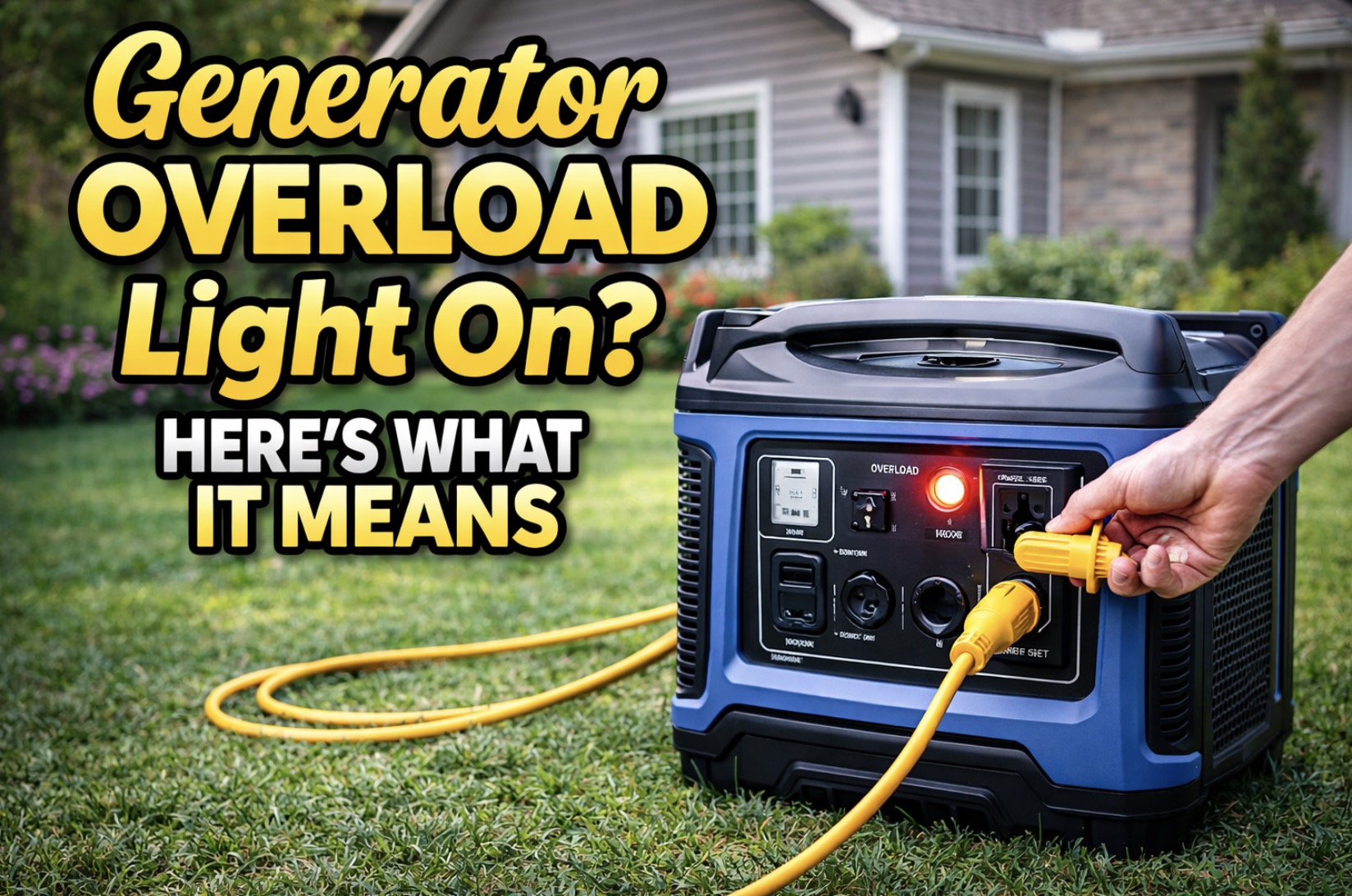
Generator Overload Light On? Here’s What It Means
* This site contains affiliate links for which we may be compensated.
* This site contains affiliate links for which we may be compensated.
If your generator’s overload light comes on, the machine is telling you that the connected load is too high, the power output is unstable, or the control system has detected a condition that could damage the generator or whatever is plugged into it. On inverter generators especially, the overload light is one of the most important warning indicators because it often appears before the generator fully shuts down or stops sending usable power to the outlets.
A lot of people assume an overload light automatically means the generator is broken. In reality, it often means the unit is doing its job by protecting itself. The challenge is figuring out whether you truly have too much plugged in, whether one appliance has a bad startup surge, or whether a component like the inverter module, breaker, or wiring is causing the warning.
For a broader look at generator components and troubleshooting, start with Generator Parts and Repairs.
What the Overload Light Actually Means
On many generators, especially inverter models, the overload light turns on when the generator senses that the output demand has exceeded what it can safely supply. That may happen because the total running wattage is too high, because one appliance has a startup surge that briefly spikes above capacity, or because a short circuit or internal fault makes the control board think the generator is under an unsafe condition.
In simple terms, the overload light means one of three things:
- The generator is being asked to power more than it is rated for.
- One connected device is causing a sudden surge or fault.
- The generator itself has an electrical problem that is triggering protection mode.
Some machines will keep the engine running but cut power to the outlets. Others will trip the breaker, flash the warning, or shut down completely. That behavior depends on the generator design.

2 Pack Watt Meter Power Meter Plug Home Electricity Usage Monitor with 1 Cord, Electrical Usage Monitor Consumption, Energy Voltage Amps Kill Meter with Backlight, Overload Protection, 7 Modes Display
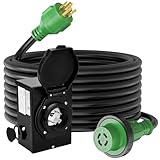
RVGUARD Emergency Power Combo Kit, 100 Foot 30 Amp Generator Cord and Power Inlet Box, NEMA L14-30P to L14-30R Generator Cord with NEMA L14-30P Pre-Drilled Generator Inlet Box, ETL Listed

PlugSaf 50FT 30 Amp Generator Extension Cord 4 Prong, NEMA L14-30P/L14-30R 10 Gauge STW 125/250V Twist Lock Generator Cord Heavy Duty, Yellow ETL Listed
The Most Common Causes of an Overload Light
The overload warning is usually tied to one of a handful of real-world problems.
- Too many appliances connected at once: The total running load may simply be above the generator’s continuous wattage rating.
- Motor startup surge: Refrigerators, air conditioners, compressors, pumps, and power tools often draw much more wattage for a second or two when starting.
- A faulty extension cord or connected appliance: A damaged cord or shorted tool can trigger overload protection quickly.
- A tripped breaker or weak receptacle connection: Heat and resistance can create unstable power flow that leads to warnings.
- Internal inverter or alternator problems: Less common, but possible if the light appears even with no meaningful load connected.
When troubleshooting, it helps to have a basic plug-in power meter, a reliable clamp meter for generator testing, or a heavy-duty generator extension cord so you are not guessing about load, amperage, or bad cords.

Reset Thermal Switch Circuit Breaker Overcurrent Overload Protector for Generator AC 125/250V (20A)

CORDMITPRO Overload Protection 30 Amp to 20 Amp Generator Distribution Adapter, NEMA L14-30P Male to 4X 5-15R/5-20R, 4-Prong 30A to Multiple Household Outlet Adapter, ETL Listed 1.5FT

Generator Electromagnetic Protector, EMP Protection, Plug Into The Socket of Inverter & Generator, Withstand Multiple High-Voltage Surges, for Home Backup, Emergencies, Grid outages
One of the biggest reasons people get confused is that their generator may seem large enough on paper, but still trips the overload light when a certain appliance kicks on. That usually comes down to startup surge, also called inrush current.
For example, a refrigerator may run at a modest wattage once it is operating normally, but its compressor can pull several times that amount at startup. The same goes for sump pumps, circular saws, shop vacs, air compressors, and many air conditioners. So even if your generator can handle the appliance’s running load, it may not have enough extra headroom for that first surge.
This is where load planning matters. A guide like Generator Load Calculation Sheet and Formula is useful because it helps you estimate not just the steady draw, but also whether several appliances starting close together could push the generator over the edge.
Signs You Are Truly Overloading the Generator
Not every overload light points to an internal failure. Very often, the warning comes with classic overload symptoms:
- The light comes on only when multiple appliances are connected.
- The warning appears when a refrigerator, pump, or air conditioner starts.
- The generator runs normally again after you unplug one or two devices.
- The engine sounds strained or changes tone right before the light appears.
- The unit works fine with lights, chargers, or a small fan but not with larger loads.
When you see those patterns, the generator is usually not defective. It is simply reaching its limit.
Signs the Problem May Be Something Else
The overload light can also show up when the actual issue is not a basic wattage overload.
- The light comes on with almost nothing plugged in.
- The light appears immediately after startup with no significant load.
- The outlets stop working even though the load is far below the rated capacity.
- The generator has visible burn marks, melted receptacles, or loose wiring.
- The warning is paired with flickering power, unstable voltage, or repeated breaker trips.
In those cases, you may be dealing with a bad outlet, damaged cord, faulty breaker, inverter control issue, or a developing alternator problem instead of a simple overload.
Step 1: Disconnect Everything and Reset the Generator
The fastest way to narrow things down is to remove all connected loads and reset the generator.
- Turn the generator off.
- Unplug every appliance and extension cord.
- Let the unit sit for a minute or two.
- Reset any breakers if your model has them.
- Restart the generator with nothing connected.
If the overload light stays off with no load, the odds strongly favor an external load problem rather than a catastrophic generator failure.
Step 2: Add Loads Back One at a Time
Once the generator is running cleanly with nothing plugged in, reconnect devices one by one.
Start with the smallest and simplest loads first, such as lights, chargers, or a fan. Then add larger devices gradually. This makes it much easier to identify whether one specific appliance is triggering the warning or whether the total combined load is the issue.
If one item immediately causes the overload light, that device may have an unusually high startup draw, an internal fault, or a damaged power cord. If the generator only overloads when several items are running together, you likely just need better load management.
Step 3: Check the Generator’s Actual Wattage Limits
Many overload problems happen because owners confuse starting watts with running watts. A generator may advertise a higher peak number, but that does not mean it can sustain that output continuously.
Make sure you compare your connected load to the generator’s running wattage, not just its maximum or surge wattage. The overload light often appears when the unit has been asked to do more than it can continuously support.
It also helps to leave a margin instead of trying to run right at the limit. In real-world use, keeping loads under about 75 to 80 percent of rated running output usually gives more stable performance and leaves room for startup surges.
Step 4: Inspect Cords, Plugs, and Receptacles
A weak cord or damaged plug can create heat, resistance, and voltage drop, which can contribute to overload-style symptoms. That is especially true when long, undersized extension cords are used with heavier loads.
Check for:
- Warm or hot plugs
- Loose-fitting connectors
- Cut or crushed insulation
- Burned blade tips on plugs
- Cheap extension cords that are too small for the load
If you are powering tools, pumps, or RV equipment, switching to a correctly sized heavy-duty generator cord can solve problems that look like generator faults but are really wiring losses and heat buildup.
Step 5: Think About Eco Mode and Sensitive Loads
On inverter generators, eco mode can sometimes make overload behavior more noticeable with surge-heavy appliances. The engine may be idling lower when a large load suddenly hits, and the generator may struggle to ramp quickly enough.
If the overload light appears when a compressor, microwave, or power tool starts, try turning eco mode off and testing again. That will not fix a true undersized generator, but it can help with borderline surge conditions.
Step 6: Test for Appliance Faults
Sometimes the generator is fine and the connected device is the real problem. A refrigerator with a failing compressor, a pump with a dragging motor, or a tool with a partially shorted winding can draw far more current than normal.
If the overload light follows one appliance no matter what else is connected, isolate that appliance and test it separately if possible. This is a common reason generators seem “too small” when, in fact, the load itself is abnormal.
Step 7: Consider Internal Generator Problems
If the overload light keeps appearing with no meaningful load, internal electrical issues move higher on the suspect list. Possible causes include:
- A failing inverter module
- A weak or damaged breaker
- Loose internal wiring
- Overheated receptacles or terminal connections
- An alternator or AVR-related fault on non-inverter models
That is where broader repair guidance becomes useful, especially if you are comfortable opening covers and checking for obvious burnt connectors, loose spade terminals, or damaged insulation. If not, it may be time for professional service.
2 Pack Watt Meter Power Meter Plug Home Electricity Usage Monitor with 1 Cord, Electrical Usage Monitor Consumption, Energy Voltage Amps Kill Meter with Backlight, Overload Protection, 7 Modes Display
RVGUARD Emergency Power Combo Kit, 100 Foot 30 Amp Generator Cord and Power Inlet Box, NEMA L14-30P to L14-30R Generator Cord with NEMA L14-30P Pre-Drilled Generator Inlet Box, ETL Listed
PlugSaf 50FT 30 Amp Generator Extension Cord 4 Prong, NEMA L14-30P/L14-30R 10 Gauge STW 125/250V Twist Lock Generator Cord Heavy Duty, Yellow ETL Listed
Once you get the generator running normally again, a few habits will reduce the chance of overload warnings returning:
- Calculate loads before an outage instead of during one.
- Start motor-driven appliances one at a time.
- Avoid running your generator at its absolute limit for long periods.
- Use short, heavy-gauge cords whenever possible.
- Keep receptacles, plugs, and breakers clean and tight.
- Choose a generator with extra headroom if you routinely power compressors, pumps, or RV air conditioners.
If you are shopping for a unit better matched to heavier loads, it can help to compare real-world options in a guide like Westinghouse Generator Reviews (Dual Fuel, Inverter, Standby), especially if you want more surge capacity, larger outlets, or a model designed for demanding home backup use.
When the Overload Light Means You Should Stop and Reassess
If the overload light keeps appearing repeatedly, do not ignore it and keep trying to force the generator through the problem. Repeated overload events create heat, stress components, and can shorten the life of both the generator and connected appliances.
A single warning may just mean you plugged in too much. Repeated warnings with light loads, however, are a sign to slow down, isolate the cause, and fix the real issue before relying on the generator again.
Summary
The overload light on a generator is a protection warning, not just an annoyance. It usually means the generator is being asked to supply too much power, a connected appliance is causing a surge or fault, or an internal electrical issue is triggering protection mode. Start by unplugging everything, resetting the unit, and adding loads back one at a time. Check your running wattage, account for startup surges, inspect cords and plugs, and do not assume the generator is bad until you rule out the simpler causes first.

Savior Generator Petcock Fuel Gas Tank Switch Shut Off Valve for Predator Champion Generac Etq Homelite Husky Powermax Replace 0j0974 (16mm x 1.5mm)
(as of March 21, 2026 12:42 GMT +00:00 - More infoProduct prices and availability are accurate as of the date/time indicated and are subject to change. Any price and availability information displayed on [relevant Amazon Site(s), as applicable] at the time of purchase will apply to the purchase of this product.)
YAMAKATO Predator 9000 8750 6500 4000 4375 Generator Fuel Tank Shut Off Valve Fuel Petcock for Centurion Honda Westinghouse Duromax Durostar Powermate Powerhorse ETQ M16X1.5mm
(as of March 21, 2026 12:28 GMT +00:00 - More infoProduct prices and availability are accurate as of the date/time indicated and are subject to change. Any price and availability information displayed on [relevant Amazon Site(s), as applicable] at the time of purchase will apply to the purchase of this product.)
WEN 55201 Magnetic Oil Dipstick for Inverter Generators (compatible with WEN, Yamaha, Predator)
(as of March 21, 2026 12:28 GMT +00:00 - More infoProduct prices and availability are accurate as of the date/time indicated and are subject to change. Any price and availability information displayed on [relevant Amazon Site(s), as applicable] at the time of purchase will apply to the purchase of this product.)
AKSGKGQ Fuel Gas Tank Grommet & Shut Off Valve Fit Coleman Powermate 4200 5000 Generator, MTD Cad Lawn Mower, Tiller replace 951-0171 Fuel Shut Off Valve 735-0149 Fuel Tank Bushing
(as of March 21, 2026 12:22 GMT +00:00 - More infoProduct prices and availability are accurate as of the date/time indicated and are subject to change. Any price and availability information displayed on [relevant Amazon Site(s), as applicable] at the time of purchase will apply to the purchase of this product.)About GeneratorStop.com
We are your #1 power generator guide and resource online. We are dedicated on providing you the best and most useful generator related articles, reviews and tools. learn more...